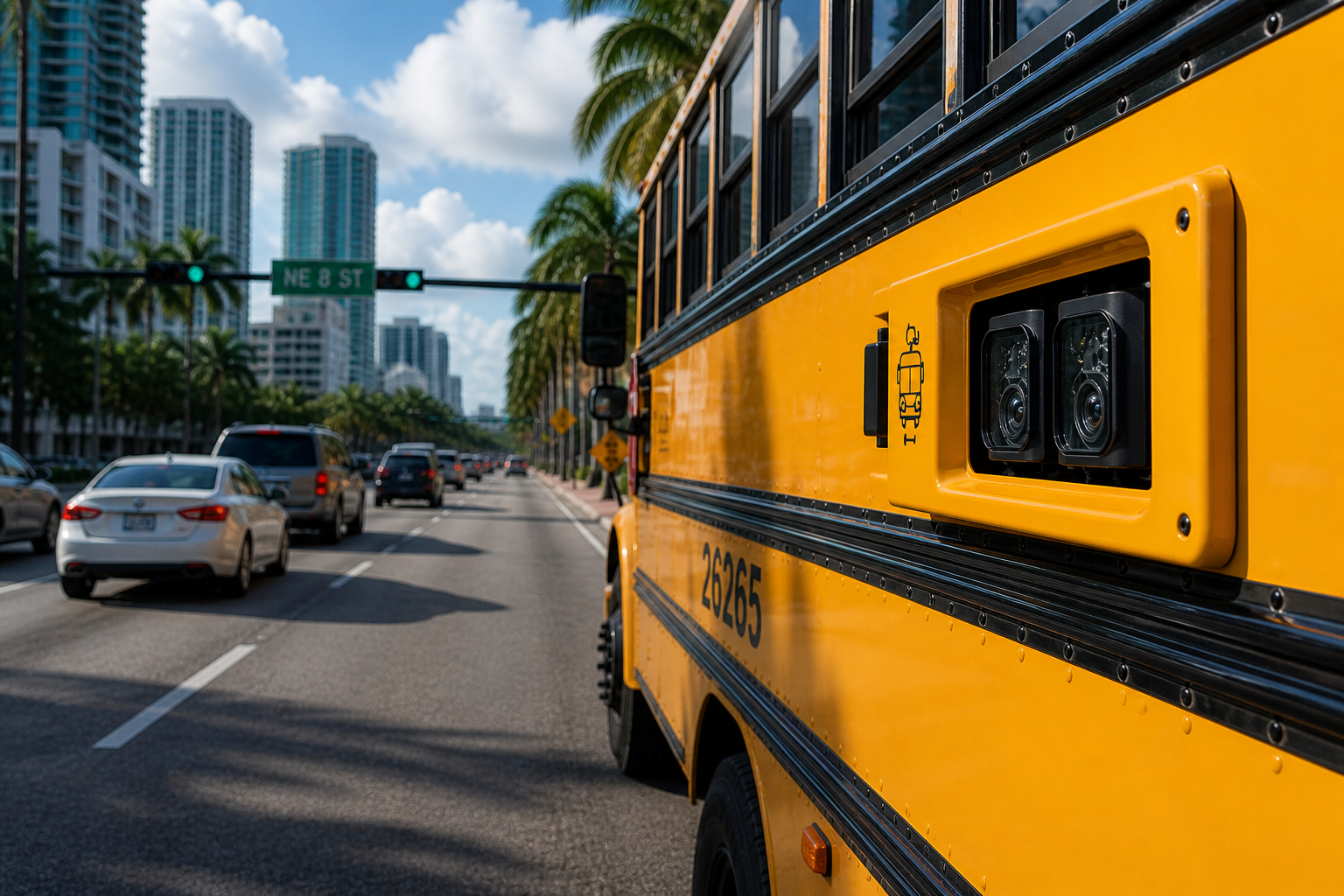
The controversial school bus camera enforcement program in Miami is officially returning, and for many drivers, it feels like a sequel no one asked for. In May 2026, the Miami-Dade Sheriff’s Office confirmed that bus-mounted cameras would once again begin issuing citations starting May 18, 2026, reviving a program that was abruptly shut down just a year earlier.
On paper, the goal is straightforward: protect children by cracking down on drivers who illegally pass stopped school buses. In reality, the first rollout turned into one of the most criticized traffic enforcement programs in South Florida in recent years. Now, with its return, drivers are left wondering whether anything meaningful has actually changed or if this is simply round two of the same problems.
A Program That Fell Apart Almost As Quickly As It Started
When the system first launched, it leaned heavily on technology provided by BusPatrol, a private vendor responsible for installing and operating the camera systems. The idea was to automate enforcement, reduce dangerous behavior, and scale up citations without requiring additional officers on the road.
But the rollout quickly raised red flags.
Reporting from the Miami Herald, along with analysis from The Ticket Clinic, painted a picture of a system that may have moved too fast and asked too few questions before going live. Concerns began to surface about how contracts were awarded, how closely vendors were working with local officials, and whether the technology itself had been thoroughly tested in real-world driving conditions.
For drivers, the experience was often confusing. Tickets showed up in the mail tied to moments that didn’t always feel like clear violations. In some cases, people insisted they were following the law but were still cited based on camera interpretation alone.
The Audit That Exposed a Bigger Problem
What initially felt like scattered complaints eventually turned into something more serious. An audit of the program revealed that the issues were not isolated. They were systemic.
Investigators found that tens of thousands of citations may have been issued under questionable circumstances. Some were dismissed outright due to technical problems, while others raised concerns about how the system determined when a violation actually occurred. There were scenarios where the positioning of the bus, the timing of the stop arm, or surrounding traffic conditions made the alleged violation far less clear than the ticket suggested.
For many drivers, it wasn’t just about the fine. It was the sense that the system itself might not be reliable.
That growing lack of confidence ultimately forced officials to shut the program down in 2025. What was supposed to be a safety initiative had turned into a credibility issue.
The 2026 Relaunch: Fixes or Just a Reset?
Fast forward to today, and the program is back, this time with assurances that improvements have been made.
According to the Miami-Dade Sheriff’s Office, the relaunch includes additional layers of review before a citation is issued, along with efforts to improve camera accuracy and ensure violations are more clearly defined. There is also supposed to be more oversight in how tickets are processed, at least in theory.
Still, many of the details remain vague, and that lack of transparency is part of what continues to concern critics. When a program has already stumbled this publicly, simply saying it has been “fixed” is not always enough to restore trust.
Follow The Money
What is more clear is exactly the revenue Bus Patrol stands to make from equipping Miami school buses with their camera system. For every one of the county’s school buses, the company will make $225 per month. Sounds reasonable until you add a $65 cut of every single ticket issued.
Let’s do some theoretical math: if the county has 900 buses with Bus Patrol, that would be $202,500 in subscription fees each month.
According to Miami Herald, the cameras were flagging more than 407 paid violations per day, 7 days per week. A $65 cut of each ticket would equate to $26,455 per day or $793,650 per month.
Based on current published numbers, Bus Patrol, a company that has been widely reported to have acquired its contract without proper vetting, along with a track record of vast technical problems, stands to make close to $1,000,000 per month in Miami-Dade.
There is also the bigger question that hasn’t gone away: how much influence do private vendors still have in a system that directly impacts thousands of drivers?
Expect Ticket Volume to Ramp Up Quickly
If the previous version of the program is any guide, this will not be a slow rollout.
When the cameras were first activated, tickets were issued at a rapid pace almost immediately. Entire corridors became high-volume enforcement zones overnight, and because the system is automated, it doesn’t take long for numbers to climb.
This is happening at a time when enforcement overall is already surging.
Data analyzed by The Ticket Clinic shows that Miami-Dade drivers experienced a dramatic increase in speeding tickets in 2025, with some weeks producing staggering numbers. In fact, recent enforcement trends have reached levels where citations are being issued at a rate that translates to multiple tickets every minute across the county.
The return of bus cameras adds another layer to that reality. It is not replacing existing enforcement, it is stacking on top of it.
Why Drivers Still See This As A Mess
Even with promised improvements, the program carries baggage that is hard to ignore.
Part of the frustration comes from the structure itself. Automated enforcement removes human discretion, which can be a double-edged sword. While it allows for consistency, it also eliminates the ability to account for nuance in real-world driving situations. Add in a private company operating behind the scenes, and it raises questions about incentives and accountability.
There is also the lingering memory of how the first rollout played out. When a program results in thousands of questionable tickets and then gets pulled entirely, it tends to leave a mark.
For many drivers, the concern is simple: if it didn’t work the first time, why should they trust it now?
Broward County Drivers, You’re Next
As if the return of Miami-Dade’s program wasn’t enough, nearby Broward County is preparing to follow a similar path.
Officials there have indicated that their own school bus camera systems are expected to be fully operational during the 2026 to 2027 school year. That means the expansion of automated enforcement across South Florida is not slowing down, it is accelerating.
For drivers who commute between counties, the odds of encountering one of these systems, and potentially receiving a ticket, are only going to increase.
What Are Your Options If You Get One?
If you receive a bus camera ticket, it is easy to assume there is no room to challenge it. After all, the citation typically comes with photos or video evidence, which can feel definitive at first glance.
But as the previous audit showed, these systems are not perfect.
There may be issues related to how the violation was captured, whether the stop arm was fully deployed, or how the situation was interpreted by the system. In some cases, procedural errors or inconsistencies in how the ticket was issued can also come into play.
It remains to be seen if these cameras and the legal procedures to manage the citations issued will actually improve. However, based on previous experiences, it’s highly probable there will be major flaws. As traffic lawyers, we will explore every possible angle to represent drivers who have been ticketed unfairly or not in accordance with the law. If you have received a bus camera ticket that you think is bogus, give us a call.
FAQ: Miami Bus Camera Tickets
When do Miami bus camera tickets start again?
The program resumes issuing citations on May 18, 2026.
Why was the program shut down before?
It was halted after audits revealed widespread technical issues, questionable citations, and oversight concerns.
Are the new cameras more reliable?
Officials say improvements have been made, but the system’s past problems have left many drivers skeptical.
How many tickets should drivers expect?
Based on the initial rollout, thousands of citations could be issued in a short period of time.
Can these tickets be challenged?
Yes, depending on the circumstances, there may be valid legal defenses.
Is this expanding to other areas?
Yes, Broward County is expected to roll out its own system during the 2026 to 2027 school year.
Final Thoughts
The return of Miami’s bus camera program is not just another policy update, it is a test of whether a controversial system can regain public trust after a highly public failure.
The intent behind the program is difficult to argue with. Protecting children around school buses is a serious issue. But intent alone does not guarantee execution, and the first version of this program showed how quickly things can go off track.
As enforcement ramps up again, drivers should stay alert, understand their rights, and be prepared to respond if a ticket shows up. Because if history repeats itself, this rollout could get messy, fast.