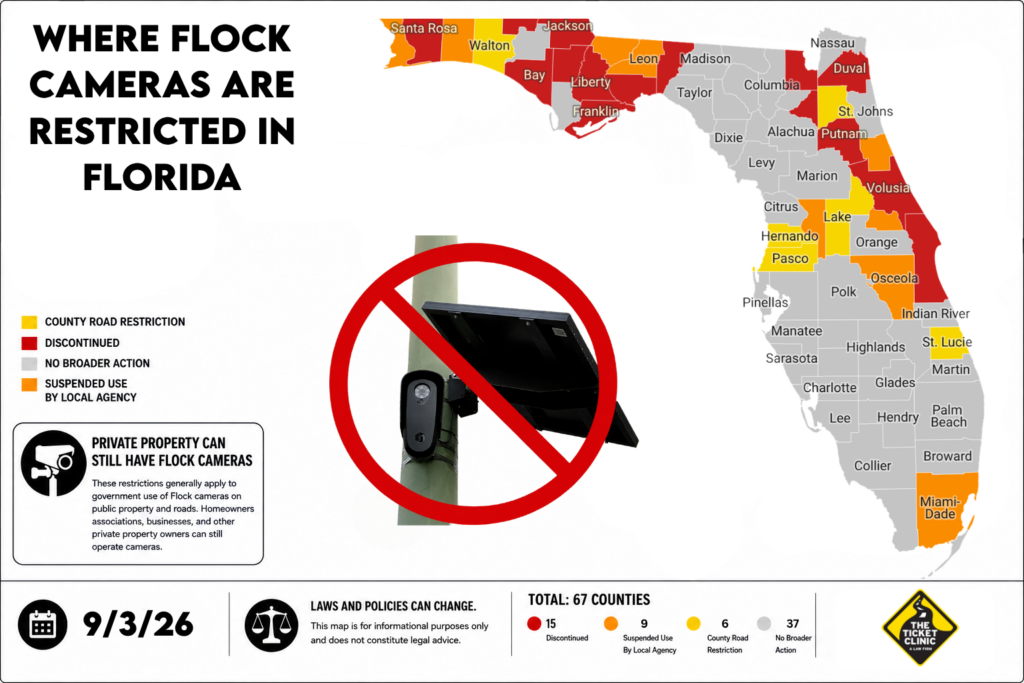
Florida is rapidly pulling back from Flock cameras and other automated license plate readers, but calling what is happening a “ban” can create confusion.
Florida has not banned Flock cameras statewide, and in many of the counties described as having “banned” the technology, the cameras themselves have not actually been made illegal.
Instead, several different things are happening at the same time.
- On August 31, 2026, the Florida Department of Transportation revoked approvals for automated license plate readers located within State Highway System rights-of-way and ordered affected cameras removed within 30 days. That action applies to cameras installed in state-controlled rights-of-way, not every Flock camera in Florida.
- Separately, some county governments have ordered cameras removed from county-controlled rights-of-way, while a growing number of sheriffs and police departments have terminated contracts, suspended their programs or stopped using Flock altogether.
But even when a sheriff’s office “bans” or discontinues Flock, that generally doesn’t mean Flock cameras are prohibited throughout that county.
Privately owned cameras may still operate at homeowners associations, gated communities, apartment complexes, shopping centers, businesses and other private properties. Municipal police departments within the same county may also have their own policies and programs.
Below is the current county-by-county status of Flock cameras in Florida as of September 10, 2026.
Click here for the Flock Camera MEGA FAQ.
Florida County Flock Camera Status
🔴 Discontinued
🟠 Suspended Use By Local Agency
🟡 County Road Restriction
⚪ No Broader Action
Status
⚪ No Broader Action
Description
State-road cameras are affected by FDOT action. The Alachua County Sheriff’s Office announced removal of ALPRs located within state-road rights-of-way, but no broader countywide shutdown or county-road restriction has been confirmed.
Description
Baker County Sheriff’s Office discontinued its use of license plate reader technology.
Description
Bay County Sheriff’s Office announced it would cease use of ALPR technology.
Description
Bradford County Sheriff’s Office directed the agency to stop using license plate readers throughout the county.
Description
Brevard County Sheriff’s Office terminated its use of and access to Flock camera data.
Status
⚪ No Broader Action
Description
No broader countywide suspension, discontinuation or county-road restriction has been confirmed.
Description
The Sheriff’s Office announced it would no longer use or access the Flock system.
Status
⚪ No Broader Action
Description
No broader suspension or discontinuation has been confirmed in Charlotte County.
Status
⚪ No Broader Action
Description
No broader county-level action has been confirmed.
Status
🟡 County Road Restriction
Description
Clay County announced removal of license plate readers from county roadways, but a complete termination of all broader Flock access has not been confirmed.
Status
⚪ No Broader Action
Description
No broader county-level action has been confirmed.
Status
⚪ No Broader Action
Description
No broader county-level action has been confirmed.
Status
⚪ No Broader Action
Description
No broader county-level action has been confirmed.
Status
⚪ No Broader Action
Description
No broader county-level action has been confirmed.
Description
Jacksonville Sheriff’s Office announced it would discontinue the use of license plate reader technology throughout Duval County.
Status
🟠 Suspended Use By Local Agency
Description
Escambia County Sheriff’s Office suspended its ALPR camera network pending clearer statewide rules and legislative guidance.
Status
🟠 Suspended Use By Local Agency
Description
Flagler County Sheriff’s Office suspended use of Flock cameras, representing a broader operational suspension rather than FDOT compliance alone.
Description
The Sheriff’s Office announced it was shutting down its broader license plate reader program.
Status
🟠 Suspended Use By Local Agency
Description
The Sheriff directed deputies to suspend access to and use of the Flock system.
Status
⚪ No Broader Action
Description
No broader county-level action has been confirmed.
Status
⚪ No Broader Action
Description
No broader county-level action has been confirmed.
Status
⚪ No Broader Action
Description
No broader county-level action has been confirmed.
Status
⚪ No Broader Action
Description
No broader county-level action has been confirmed.
Status
⚪ No Broader Action
Description
No broader county-level action has been confirmed.
Status
⚪ No Broader Action
Description
No broader county-level action has been confirmed.
Status
🟡 County Road Restriction
Description
The Sheriff’s Office initiated removal of Flock cameras from county-maintained rights-of-way; no full program shutdown has been confirmed.
Status
⚪ No Broader Action
Description
No broader county-level action has been confirmed.
Status
⚪ No Broader Action
Description
No broader countywide suspension, discontinuation or county-road restriction has been confirmed.
Description
The Sheriff’s Office stopped using its Flock camera system.
Status
⚪ No Broader Action
Description
No broader county-level action has been confirmed.
Description
Jackson County Sheriff’s Office stopped using license plate reader cameras.
Description
The Sheriff’s Office shut down its Flock cameras and ended their collection of vehicle data.
Status
⚪ No Broader Action
Description
No broader county-level action has been confirmed.
Status
🟡 County Road Restriction
Description
The County Commission voted to rescind authorization for ALPR cameras in county rights-of-way and direct that affected cameras be turned off and removed.
Status
⚪ No Broader Action
Description
No broader countywide suspension, discontinuation or county-road restriction has been confirmed.
Status
🟠 Suspended Use By Local Agency
Description
The Leon County Sheriff’s Office suspended or turned off Flock cameras under its control. On September 9, the Tallahassee City Commission separately voted to suspend the city’s 150-camera ALPR network.
Status
⚪ No Broader Action
Description
No broader county-level action has been confirmed.
Description
The Sheriff’s Office ceased participation in the Flock program and moved to end its contract while legal and constitutional questions are reviewed.
Status
⚪ No Broader Action
Description
No broader county-level action has been confirmed.
Status
⚪ No Broader Action
Description
County commissioners restricted future Flock installations at certain county facilities, but existing Sheriff’s Office use and county-road cameras were not broadly discontinued.
Status
⚪ No Broader Action
Description
No broader county-level action has been confirmed.
Status
⚪ No Broader Action
Description
No broader county-level action has been confirmed.
Status
🟠 Suspended Use By Local Agency
Description
Miami-Dade Sheriff’s Office suspended its license plate reader program in its entirety.
Status
⚪ No Broader Action
Description
No broader county-level action has been confirmed.
Status
⚪ No Broader Action
Description
FDOT-affected cameras are being removed, but no broader countywide shutdown or county-road restriction has been confirmed.
Status
🟠 Suspended Use By Local Agency
Description
Okaloosa County Sheriff’s Office suspended its broader ALPR program while statewide policy and legislative issues are reviewed.
Status
⚪ No Broader Action
Description
No broader county-level action has been confirmed.
Status
⚪ No Broader Action
Description
The Sheriff’s Office has indicated it will continue using license plate readers where permitted.
Status
🟠 Suspended Use By Local Agency
Description
The Sheriff announced the agency would deactivate its use of Flock cameras pending clearer statutory safeguards.
Status
🟡 County Road Restriction
Description
Palm Beach County commissioners paused approval of new automated license plate reader permits on county-controlled roads while officials review privacy, oversight and public-safety concerns. Existing law-enforcement ALPR use has not been completely discontinued.
Status
🟡 County Road Restriction
Description
The Sheriff’s Office is terminating the interlocal agreement covering approximately 60 cameras in county rights-of-way; this is not a complete countywide prohibition on ALPR technology.
Status
⚪ No Broader Action
Description
No broader countywide shutdown has been confirmed beyond compliance with applicable state requirements.
Status
⚪ No Broader Action
Description
The Sheriff’s Office intends to continue using license plate readers outside State Highway System rights-of-way.
Description
Putnam County Sheriff’s Office discontinued its Flock program and moved to disconnect its ALPR cameras.
Description
Santa Rosa County Sheriff’s Office announced it would no longer use Flock cameras.
Status
⚪ No Broader Action
Description
No broader countywide suspension, discontinuation or county-road restriction has been confirmed.
Status
🟠 Suspended Use By Local Agency
Description
Seminole County Sheriff’s Office suspended its broader use of Flock ALPR technology.
Status
⚪ No Broader Action
Description
The Sheriff’s Office confirmed it will remove cameras affected by the FDOT state-road order. No broader countywide suspension or discontinuation has been confirmed.
Status
🟡 County Road Restriction
Description
County commissioners voted to remove Flock cameras and other ALPRs from all county-controlled rights-of-way and county property, going beyond the FDOT state-road action.
Status
🟠 Suspended Use By Local Agency
Description
Sumter County Sheriff’s Office suspended its use of Flock license plate reader cameras.
Status
⚪ No Broader Action
Description
No broader county-level action has been confirmed.
Status
⚪ No Broader Action
Description
No broader county-level action has been confirmed.
Status
⚪ No Broader Action
Description
No broader county-level action has been confirmed.
Description
Volusia County Sheriff’s Office shut down its broader Flock/license plate reader program.
Description
Wakulla County Sheriff’s Office ended its broader Flock/license plate reader program.
Status
🟡 County Road Restriction
Description
The County Commission voted 5–0 to remove ALPR cameras from county-owned and maintained rights-of-way; the action does not amount to a complete countywide Flock ban.
Status
⚪ No Broader Action
Description
No broader county-level action has been confirmed.
* Camera counts: Counts reflect publicly reported or documented cameras where available and may include estimates. State-road action may affect cameras within counties that otherwise remain classified as having no broader countywide action.
Florida City & Municipality Flock Camera Status
🔴 Discontinued / Removing
🟠 Suspended / Paused
🟡 Under Review / Limited Action
⚪ Continuing / Operating
Status
🟡 Removing Affected Cameras
Description
Alachua Police confirmed nine license plate readers affected by the state-road directive are being removed. The city has not announced a complete termination of its broader ALPR program.
Description
Altamonte Springs Police suspended use of the Flock ALPR camera network while awaiting clearer statewide standards governing access, data retention, sharing and auditing.
Description
Atlantic Beach suspended its use of Flock Safety technology and will no longer use automated license plate readers across municipal operations.
Description
Cape Coral Police discontinued its use of Flock ALPR technology. The department may reevaluate the technology if Florida establishes a clearer statewide regulatory framework.
Description
Casselberry Police suspended use of the Flock camera system until further notice as Florida reviews the use and regulation of ALPR technology.
Description
Clermont Police suspended its ALPR program while awaiting clearer statewide rules concerning privacy, data retention, access and information sharing.
Description
Cocoa Beach removed officer access to the Flock system pending significant legislative changes or additional statewide guidance.
Description
Edgewater suspended its use of the Flock ALPR system pending further review and statewide guidance.
Status
🟠 Access Suspended
Description
Eustis Police said it will comply with Florida’s new ALPR direction and follow state plans and guidelines while access to the technology is unavailable.
Description
Fernandina Beach Police moved to end the city’s use of Flock license plate reader cameras.
Description
Gainesville Police suspended use of its automated license plate reader cameras effective September 3. Cameras operated by GPD were turned off while the department monitors potential legislation and community concerns involving privacy and individual rights.
Description
Groveland Police suspended all Flock ALPR cameras and personnel access while the city evaluates oversight, governance and future use of the technology.
Description
Gulf Breeze discontinued its Flock/ALPR camera program.
Description
Jacksonville Beach Police confirmed it will continue using Flock license plate readers in locations where the technology is legally permitted and considered appropriate, while removing cameras affected by the state-road directive.
Description
Lady Lake Police suspended its use of Flock license plate reader technology amid the statewide review of ALPR systems.
Status
🟠 Suspended / Removing
Description
Melbourne Police suspended Flock use, deactivated user accounts and began taking cameras offline while the city moves toward ending the program.
Status
🟡 Continuing / Reviewing
Description
Miami Beach has not announced a broader shutdown. City leadership has opposed removing ALPR cameras from state roads and has advocated for continued local use.
Description
Neptune Beach Police discontinued use of license plate reader technology on roadways within the city effective immediately.
Status
🔴 Removing Program
Description
Oviedo moved to remove its entire Flock camera program rather than limit its response to cameras located on state roads.
Status
⚪ Operating / Pending Review
Description
Palm Bay restored operation of its Flock camera network following a permitting and installation review while city officials continue reviewing the future of the program.
Status
🟡 Funding Removed / Under Review
Description
The Panama City CRA Board voted to remove FY2027 funding allocated for 25 Flock cameras while the future of the broader city program remains under review.
Status
🟠 Suspended / Removing
Description
Panama City Beach Police ended access to and use of the Flock system and indicated the department would coordinate removal of the cameras.
Description
Pensacola Police suspended use of its ALPR system pending additional legislative action and clearer statewide guidance.
Description
Port St. Lucie Police paused normal use of all ALPR technology. Access is limited to exigent circumstances involving an immediate threat to life or serious bodily harm.
Description
Sanford Police suspended its use of Flock ALPR technology pending further review and statewide guidance.
Description
St. Cloud Police discontinued its use of the Flock ALPR camera network effective immediately.
Status
🟡 Under City Review
Description
St. Petersburg has not announced a broader shutdown. The city’s Flock contract and Police Department use of the system have been referred for City Council committee review.
Description
The Tallahassee City Commission voted unanimously on September 9, 2026, to suspend the city’s entire 150-camera automated license plate reader network. The system includes Flock Safety and Motorola ALPR cameras. The city action follows the earlier suspension of Flock camera use by the Leon County Sheriff’s Office.
Description
Tampa is complying with requirements affecting cameras located on state-controlled roads, but no broader citywide shutdown has been announced.
Description
Titusville Police temporarily paused its Flock ALPR program. Standard user accounts have been disabled while officials review the technology and await additional statewide guidance.
Description
Winter Springs Police suspended use of Flock cameras and associated ALPR technology pending further review and statewide guidance.
* Camera counts: Counts reflect publicly reported or documented cameras where a reliable figure is available. A dash does not mean the municipality has no cameras; it means a sufficiently reliable current program count has not been established.
Important: Municipal policies can differ from the surrounding county. A county’s decision to suspend, discontinue or restrict Flock cameras does not necessarily mean every city or privately operated camera within that county has been shut down.
Last updated: September 10, 2026. The Ticket Clinic will continue updating this page as additional Florida counties, cities and law enforcement agencies discontinue, suspend or restrict automated license plate reader programs.