Several Florida laws take effect on October 1, 2026. They change when drivers must report certain crashes, clarify the rules for license plate frames, expand the use of email for state motor vehicle notices, restrict nitrous oxide at certain retailers, and update the specialty license plate program.
Here is what Florida drivers should know.
SB 488 Changes Crash Reporting and License Plate Frame Rules
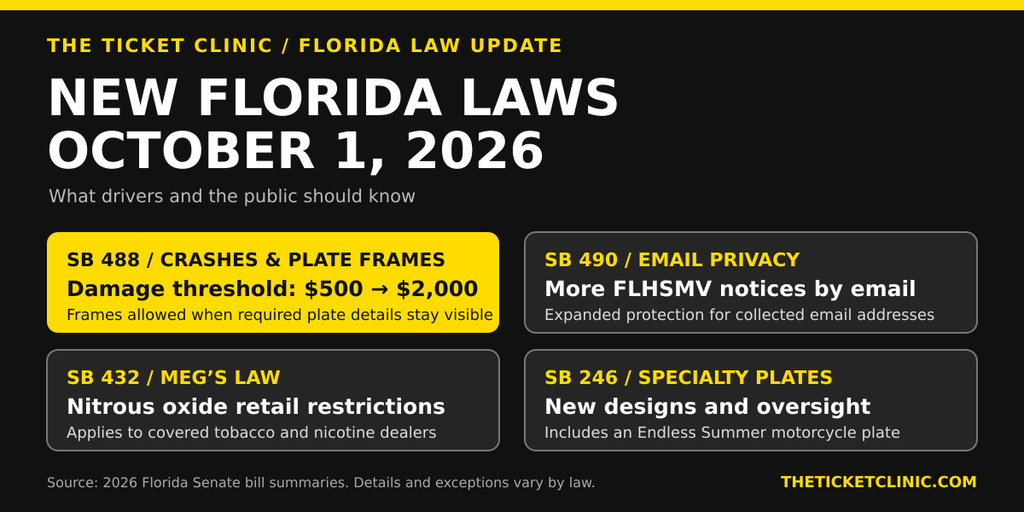
SB 488 raises the estimated property damage threshold that requires a driver to notify law enforcement after a crash from $500 to $2,000. The change applies to the damage threshold. Other circumstances, including injuries, may still require a report. Since damage can be difficult to estimate at the scene, drivers should document the vehicles, location, and information exchanged with the other people involved.
The law also clarifies that a license plate frame or decorative border is allowed as long as it does not obscure the plate number or validation sticker. Drivers should check their frames to make sure that information remains visible.
SB 488 also gives the Florida Department of Highway Safety and Motor Vehicles, or FLHSMV, broader authority to send certain notices by email instead of postal mail. Drivers should make sure the email address associated with their state records is current.
License Plate Frames: Why Florida Is Clarifying the Rule
Florida’s license plate frame rule caused an uproar in late 2025 and early 2026. A law that took effect in October 2025 increased the penalty for knowingly interfering with a plate’s legibility from a traffic infraction to a criminal misdemeanor. Drivers began asking whether an ordinary dealership frame could lead to a traffic stop or even an arrest. Reports of a mistaken arrest and citations added to the concern. State officials issued guidance in December explaining that the focus was on whether officers could see the plate number and registration decal.
SB 488 puts a clearer rule into the statute beginning October 1, 2026: a plate frame or decorative border is allowed if it does not obscure the plate number or the validation sticker in the upper right corner. A frame may overlap words or artwork along the bottom of a plate, provided those identifying features remain visible. The change clarifies the status of ordinary frames; it does not permit a cover or device that interferes with reading or recording the plate number or sticker.
Before driving, take a quick look at your plate from behind the vehicle. If the frame covers any letter or number, or even part of the registration decal, adjust or remove it.
SB 490 Protects Email Addresses Collected by FLHSMV
SB 490 accompanies the expanded email notification provisions in SB 488. It broadens the public records exemption for email addresses that FLHSMV collects to send notices. It also protects addresses used for certain vessel title and lien renewal notices.
For drivers, the practical change is that email may become a more important way to receive information from FLHSMV, including some notices involving a license or registration. Keep your contact information current. If a message asks for payment or personal information, verify it through an official FLHSMV channel before responding.
Meg’s Law Restricts Nitrous Oxide at Certain Retailers
CS/SB 432 includes Meg’s Law, which takes effect on October 1. It prohibits covered tobacco and nicotine dealers and their employees from possessing, selling, delivering, or giving away nitrous oxide on or from their licensed premises. A violation is a third-degree felony.
The provision includes exceptions for grocery stores and supermarkets, but those exceptions do not apply to convenience stores. Finished food products that use nitrous oxide solely as a propellant are also excluded from the prohibition. These details matter: Meg’s Law places specific restrictions on covered retailers. It does not prohibit every lawful use of nitrous oxide.
The bill also addresses xylazine. Some of those provisions took effect on a different date, so it would be inaccurate to say that every part of CS/SB 432 begins on October 1.
CS/SB 246 Updates Florida’s Specialty License Plates
CS/SB 246 authorizes several new specialty license plates, including an Endless Summer plate for motorcycles. It also changes how organizations behind newly approved plates report their projected revenue and expenses. Those organizations must submit a financial projection covering five years.
The law expands eligibility for the Fraternal Order of Police specialty plate and changes how proceeds from that plate are distributed. For most drivers, the law adds or changes plate choices rather than creating a new rule of the road.
CS/SB 246 is the bill that became law. HB 639 was a related proposal, but it should not be identified as the enacted measure.
What Drivers Should Check Before October 1
Look at your license plate frame to confirm that it leaves the plate number and validation sticker visible. Check that FLHSMV has your current email address, and pay attention to official notices you receive. If you are involved in a crash, remember that the higher property damage threshold does not settle every question about whether the crash must be reported.
The laws have different effects. Some change everyday driver procedures; others primarily affect retailers or specialty plate organizations. When a particular crash, citation, or criminal charge is involved, the applicable law and the facts of the incident should be reviewed together.