Every year, Florida lawmakers pass dozens of new laws, but only a handful directly affect the state’s millions of drivers. Beginning July 1, 2026, several new laws changed how repeat traffic offenders are treated, created new programs for motorists, tightened restrictions on the sale of nitrous oxide, and updated transportation policies across the state.
While some of these changes are administrative, others could have serious consequences for your driving privileges or how you interact with law enforcement. For example, drivers who repeatedly operate a vehicle without a valid license now face a much greater risk of being designated a Habitual Traffic Offender, while new programs aim to improve communication and safety during traffic stops.
In this guide, we’ll break down the most important traffic and transportation laws that took effect on July 1, explain why they were passed, discuss potential penalties, and highlight what Florida drivers should know before getting behind the wheel. Whether you’re a daily commuter, commercial driver, or simply trying to stay informed, understanding these changes can help you avoid costly mistakes and better understand your rights and responsibilities on Florida roads.
Quick Reference Guide
| Bill | Law / Topic | What Changed | Primary Impact | Who Is Affected |
|---|---|---|---|---|
| HB 35 | Habitual Traffic Offender (Isaiah’s Law) | Driving without a valid driver’s license now counts toward Habitual Traffic Offender (HTO) designation. | Repeat offenders may lose their license for up to five years and face felony charges for driving after HTO designation. | Florida drivers, especially repeat traffic offenders |
| SB 418 | Blue Envelope Program | Creates a voluntary Blue Envelope Program for drivers with Autism Spectrum Disorder to improve communication during traffic stops. | Helps reduce misunderstandings between law enforcement and motorists. | Drivers with autism, law enforcement |
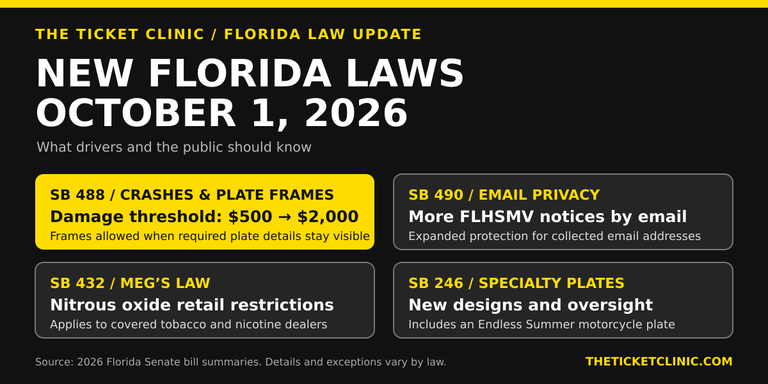
| SB 432 (Effective October 2026) | Meg’s Law (Nitrous Oxide Restrictions) | Restricts the sale and marketing of nitrous oxide products intended for recreational inhalation while preserving legitimate commercial and medical uses. | Creates new criminal penalties for unlawful sales and aims to reduce impaired driving and substance abuse. | Retailers, consumers, law enforcement |
| SB 212 | Sex Offender Restrictions | Adds public swimming pools to locations where certain registered offenders may not live or loiter and expands enforcement authority. | Strengthens protections for children and increases enforcement options. | Registered offenders, law enforcement |
| HB 445 | Dangerous Crimes / Pretrial Release | Adds additional child exploitation offenses to Florida’s “dangerous crimes” list, making pretrial release more restrictive. | More defendants may remain in custody while awaiting trial. | Criminal defendants, prosecutors, victims |
| HB 277 | Animal Cruelty | Strengthens criminal laws related to serious animal cruelty offenses and investigations. | Increases accountability and strengthens prosecution of abuse cases. | Pet owners, animal abusers, law enforcement |
| HB 359 | Criminal Procedure Updates | Modernizes portions of Florida’s criminal investigation and court procedures. | Improves efficiency and clarifies legal processes. | Courts, attorneys, law enforcement |
| SB 436 | Criminal Penalty Enhancements | Increases penalties and updates sentencing for certain criminal offenses. | Harsher punishment for qualifying crimes. | Criminal defendants |
| HB 477 | Xylazine Test Strips | Removes xylazine testing products from Florida’s definition of illegal drug paraphernalia. | Allows possession of testing devices used solely to detect xylazine. | Public health organizations, consumers |
| SB 584 | Commercial Driving Schools | Increases oversight of commercial driving schools and authorizes additional enforcement against fraudulent operators. | Improves CDL training standards and consumer protection. | CDL students, driving schools |
| SB 628 | Transportation Facility Designations | Renames numerous highways, roads, and transportation facilities across Florida, including a portion of SR-80 as the President Donald J. Trump Highway. | Honorary roadway designations only; no changes to traffic laws. | Florida motorists |
| HB 33 | Roadway Designations | Renames several state roadways, including President Donald J. Trump Boulevard and Charlie Kirk Memorial Avenue. | Updates roadway signage only. | Florida motorists |
| HB 1069 | Background Screening | Expands and updates criminal background screening requirements for certain regulated professions and programs. | Strengthens protections for vulnerable populations. | Employers, applicants, licensing agencies |
| HB 1159 | Child Sexual Exploitation | Creates tougher penalties for child exploitation offenses, including AI-generated child sexual abuse material, and increases mandatory minimum sentences. | One of Florida’s strongest child protection laws enacted in 2026. | Criminal defendants, prosecutors, victims |
Traffic & Driver Laws
HB 35 – Driving Without a Valid License Now Counts Toward Habitual Traffic Offender Status (Isaiah’s Law)
What’s changing?
One of the most significant traffic law changes taking effect this year is House Bill 35, which expands Florida’s Habitual Traffic Offender (HTO) law.
Before this change, Habitual Traffic Offender status generally applied to drivers who accumulated repeated convictions for serious traffic offenses such as:
- Driving while license suspended or revoked
- DUI-related offenses
- Leaving the scene of a crash
- Serious moving violations
Beginning July 1, 2026, driving without a valid driver’s license has been added to the list of qualifying offenses that can lead to Habitual Traffic Offender designation after the required number of convictions within a five-year period.
Why was the law passed?
The legislation, commonly referred to as Isaiah’s Law, was introduced after a fatal crash involving a repeat unlicensed driver.
Supporters argued that individuals who repeatedly drive without obtaining legal driving privileges demonstrate a pattern of ignoring traffic laws and should face stronger consequences before another tragedy occurs.
Rather than treating repeated “No Valid Driver License” offenses as relatively minor violations, lawmakers chose to make them part of Florida’s repeat offender system.
Penalties
Being designated a Habitual Traffic Offender carries serious consequences.
Drivers may face:
- Revocation of driving privileges for up to five years
- Additional criminal charges for continuing to drive after designation
- Prosecution for a third-degree felony if caught driving after becoming an HTO
- Possible jail or prison time, probation, fines, and a permanent criminal record depending on the circumstances.
Potential impact on Florida drivers
For many drivers, this may be the most important traffic law enacted during the 2026 legislative session.
Many people mistakenly believe driving without a valid license is simply another traffic citation. Under HB 35, repeated convictions can now trigger significantly harsher consequences that extend well beyond traffic court.
The law is expected to primarily affect repeat offenders rather than first-time violators, but it demonstrates Florida’s continued focus on removing habitual offenders from the road.
SB 418 – Florida Creates the Blue Envelope Program
What’s changing?
Senate Bill 418 establishes Florida’s Blue Envelope Program, a voluntary initiative designed to improve interactions between law enforcement officers and drivers with Autism Spectrum Disorder during traffic stops.
Beginning January 1, 2027, eligible Floridians may request a blue envelope from the Florida Department of Highway Safety and Motor Vehicles or their local tax collector’s office.
The envelope is intended to hold:
- Driver’s license
- Vehicle registration
- Insurance information
It also includes communication guidance that alerts officers the driver may have autism and may communicate differently during the stop.
Why was the law passed?
Traffic stops can be stressful for anyone, but they may be particularly challenging for individuals with autism who experience sensory overload, delayed communication, or difficulty responding to unexpected situations.
The program aims to reduce misunderstandings while improving safety for both motorists and law enforcement.
Several other states have implemented similar programs with positive results.
Penalties
This law does not create any new criminal penalties or traffic violations.
Participation is completely voluntary.
Potential impact
Although this law won’t change traffic enforcement itself, it could improve communication during roadside encounters and reduce unnecessary escalation during routine traffic stops.
SB 584 – Increased Oversight of Commercial Driving Schools
What’s changing?
Florida has strengthened oversight of commercial driving schools through Senate Bill 584.
The law authorizes county tax collectors to enter into agreements with the Florida Department of Highway Safety and Motor Vehicles to help enforce regulations governing commercial driving schools.
The goal is to identify and investigate schools engaging in fraudulent or deceptive business practices.
Why was the law passed?
Commercial driver’s licenses play a critical role in highway safety.
Lawmakers determined additional oversight could help prevent fraudulent schools from improperly certifying drivers or misleading students seeking CDL training.
Penalties
Schools found violating Florida law may face:
- Administrative enforcement actions
- Licensing consequences
- Civil penalties
- Other sanctions depending on the nature of the violations
Potential impact
Most commercial driver applicants will never notice the change.
However, the law should improve accountability among CDL schools while helping ensure that commercial drivers receive legitimate training before operating large commercial vehicles on Florida roads.
Transportation Infrastructure
HB 33 – New Roadway Designations
What’s changing?
House Bill 33 officially renames several Florida roadways.
Among the new designations are:
- President Donald J. Trump Boulevard, a portion of State Road 870 in Broward County.
- Charlie Kirk Memorial Avenue, a portion of State Road 985 in Miami-Dade County.
The Florida Department of Transportation is responsible for installing the new roadway markers.
Why was the law passed?
These roadway designation bills are honorary in nature and recognize individuals through official highway naming.
Penalties
None.
This legislation does not affect traffic laws, speed limits, or roadway enforcement.
Potential impact
For most drivers, the only noticeable change will be updated highway signage.
SB 628 – New Highway Designations Across Florida
What’s changing?
Senate Bill 628 renames more than a dozen transportation facilities throughout Florida.
The largest roadway designation creates the President Donald J. Trump Highway, covering approximately 124 miles of State Road 80 from Palm Beach County to Lee County.
The legislation also renames Tallahassee International Airport as Bobby Bowden-Tallahassee International Airport along with several additional roadway designations statewide.
Why was the law passed?
Like HB 33, this bill primarily recognizes notable public figures through honorary transportation designations.
Penalties
None.
Potential impact
Drivers traveling these roadways will eventually notice updated highway signs as the Florida Department of Transportation installs the new markers.
Final Thoughts?
Of all the transportation-related laws taking effect this year, HB 35 stands out as the one most likely to affect the average Florida driver.
Unlike honorary roadway naming bills or administrative changes, HB 35 directly increases the consequences for repeat traffic offenders by expanding the list of offenses that can lead to Habitual Traffic Offender designation. Drivers who repeatedly operate a vehicle without a valid license now face much greater long-term consequences than they did under prior law.
Florida’s traffic laws are constantly evolving, and even seemingly small legislative changes can have a significant impact on your driving privileges, insurance rates, or criminal record. Staying informed is one of the best ways to avoid costly mistakes and understand your rights when you’re on the road.
At The Ticket Clinic, we’re committed to doing more than defending drivers after they receive a ticket. Our goal is to help motorists stay informed about new traffic laws, enforcement trends, and legal changes that could affect drivers throughout Florida and across the country. As lawmakers continue to introduce new legislation, we’ll be here to break down what changed, why it matters, and what it means in plain English.
The Ticket Clinic Team
We are the largest law firm in the United States to focus solely on traffic-related offenses and traffic tickets. Over +35 years in business, we have developed deep knowledge about traffic court procedure and traffic laws. Our goal is to help keep drivers stay informed about legal issues that could affect them on the road. In our blog content, we like to explore insights in traffic ticket trends and other related issues.