
Electric bicycles have quickly become a common sight on Florida’s roads, sidewalks, beaches and recreational trails. Their growing popularity, however, has created an increasingly complicated legal environment for riders.
Florida law generally gives a qualifying electric bicycle the same rights and responsibilities as a conventional bicycle. That does not mean the rules are identical everywhere. Florida municipalities and counties can regulate where e-bikes may be operated. Local governments can also establish minimum rider ages and require riders to carry government-issued photo identification.
As a result, an e-bike that is legal on a sidewalk or shared-use path in one Florida community may be restricted just a few miles away. Some cities prohibit e-bikes on sidewalks or beaches, while others impose lower speed limits, minimum-age requirements, identification rules or restrictions in parks and busy pedestrian areas.
Florida’s E-Bike Rules Are Changing Quickly
Florida’s local e-bike laws are developing rapidly. During 2025 and 2026, cities and counties across the state considered or adopted new restrictions in response to concerns involving speed, inexperienced riders, pedestrian safety and high-powered electric motorcycles being incorrectly treated as e-bikes.
The result is a patchwork of local regulations. Key Biscayne and Miami Beach have adopted significant location-based prohibitions. Sunny Isles Beach, Jupiter, Palm Coast and Wellington have established minimum-age or identification requirements. Other communities, including Marco Island, Fort Myers Beach, Atlantic Beach, Neptune Beach and Fernandina Beach, have adopted special speed limits for sidewalks, shared paths or beach areas.
Other proposals remain under consideration. A proposed restriction should not be confused with an enacted ordinance, and rules governing commercial scooter or bicycle rental programs may not necessarily apply to someone riding a privately owned e-bike.
This Florida E-Bike Restriction Tracker separates enacted rider restrictions from pending proposals and shared-mobility program regulations. We will continue updating this page as municipalities and counties adopt, amend, repeal or clarify their local ordinances.
Because this is a rapidly changing area of Florida law, riders should also check posted signs and current local rules before using an e-bike on a beach, sidewalk, trail, park or other public property.
What Qualifies as an Electric Bicycle in Florida?
Under Florida law, an electric bicycle must have fully operable pedals, a seat or saddle and an electric motor rated at less than 750 watts. It must also fall within one of three classifications.
Class 1 Electric Bicycle
A Class 1 e-bike provides assistance only while the rider is pedaling. Motor assistance must stop when the bicycle reaches 20 mph.
Class 2 Electric Bicycle
A Class 2 e-bike may use a throttle and propel the rider without pedaling. Motor assistance must stop when the bicycle reaches 20 mph.
Class 3 Electric Bicycle
A Class 3 e-bike provides assistance only while the rider is pedaling. Motor assistance must stop when the bicycle reaches 28 mph.
A device without functional pedals, with a motor rated at 750 watts or more, or capable of operating outside Florida’s statutory speed classifications may not qualify as an electric bicycle. High-powered devices commonly marketed as “e-motos” or electric dirt bikes may instead fall under laws governing motorcycles, mopeds or other motor vehicles. Simply calling a vehicle an e-bike does not make it one under Florida law.
Qualifying e-bikes do not ordinarily require a driver’s license, vehicle registration, title or automobile insurance under state law. Riders are nevertheless subject to traffic laws governing bicycles and any additional ordinance adopted by the local jurisdiction.
How to Use the Florida E-Bike Restriction Tracker
The tracker below identifies Florida municipalities and counties where a rider-facing restriction has been confirmed or where officials are considering a new regulation:
- Broad Prohibition: E-bike operation is prohibited across multiple public locations or in an especially significant area.
- Age, ID or Sidewalk Restrictions: The jurisdiction imposes rider qualifications or limits sidewalk operation.
- Speed or Location Restrictions: Special rules apply on beaches, paths, sidewalks, parks or other designated locations.
- Proposed or Pending: Officials are considering a regulation, but final adoption has not been confirmed.
- Shared-Mobility Regulation: The ordinance primarily governs rental companies or shared-device programs and may not apply equally to privately owned e-bikes.
This tracker was last updated in September 2026. It is provided for general informational purposes and is not legal advice. Local ordinances, posted restrictions and enforcement policies can change without immediate notice.
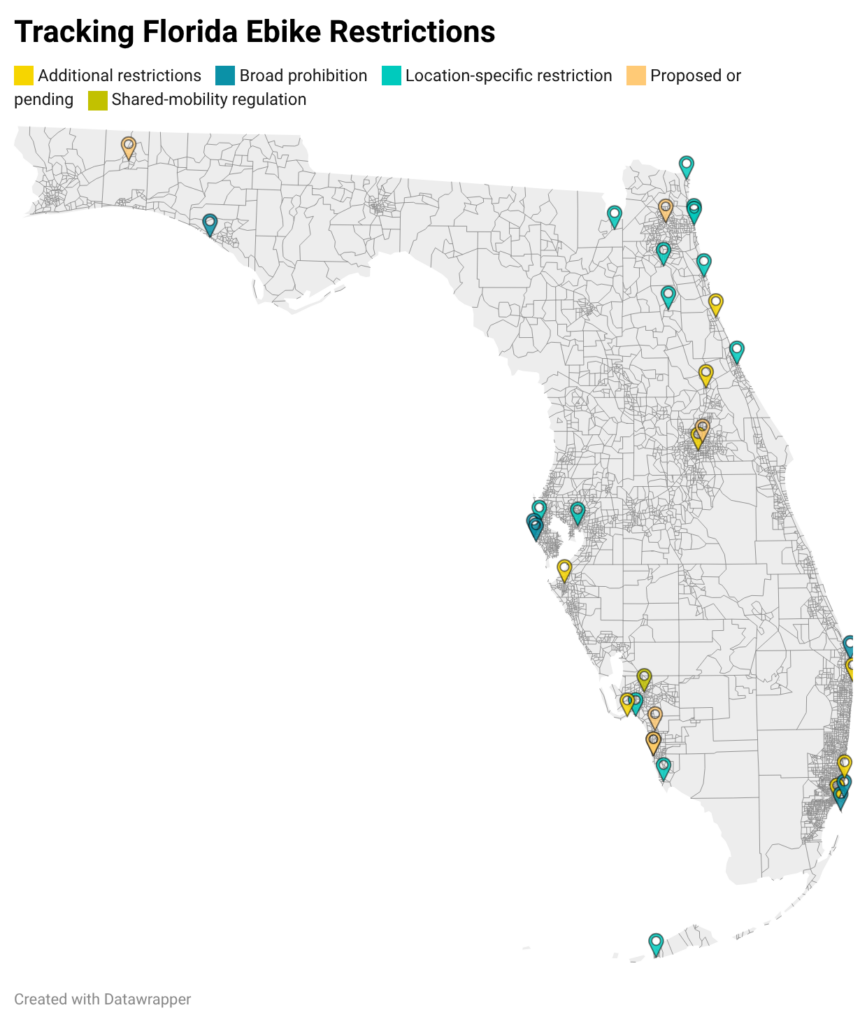
Florida E-Bike Restrictions by County and Municipality
Florida generally treats qualifying electric bicycles like traditional bicycles, but counties and municipalities may establish additional rules. These local regulations may restrict rider ages, speeds, sidewalks, beaches, parks, trails and other public areas.
County Restrictions
City and Municipality Restrictions

The Ticket Clinic Team
We are the largest law firm in the United States to focus solely on traffic-related offenses and traffic tickets. Over +35 years in business, we have developed deep knowledge about traffic court procedure and traffic laws. Our goal is to help keep drivers stay informed about legal issues that could affect them on the road. In our blog content, we like to explore insights in traffic ticket trends and other related issues.