Careless driving is one of the most commonly issued moving violations in Florida—and one of the broadest.
In 2025, Florida law enforcement agencies issued 146,069 careless driving citations statewide, according to Florida Uniform Traffic Citation data analyzed by The Ticket Clinic. That makes careless driving one of Florida’s most frequently issued traffic citations.
It is also a ticket that drivers commonly receive after a car accident.
Unlike speeding, running a stop sign, or making an improper lane change, careless driving does not describe one specific prohibited maneuver. Florida’s careless driving law essentially requires motorists to drive reasonably given the conditions around them.
That gives police officers considerable discretion when deciding whether a driver’s actions amount to careless driving.
Here is what Florida drivers should know about careless driving tickets, including what behavior can result in a citation, what happens when the ticket is connected to a crash, the potential insurance consequences, and how a traffic lawyer may challenge the charge.
What Is Careless Driving in Florida?
Florida’s careless driving law is found in Florida Statute §316.1925.
The statute requires every person operating a vehicle on Florida’s streets and highways to drive in a “careful and prudent manner”, taking into consideration factors including the width and condition of the roadway, curves, corners, traffic and other surrounding circumstances.
A driver who fails to do so in a way that endangers another person’s life, safety or property can be cited for careless driving.
Florida classifies a violation of §316.1925 as a moving violation.
The key to understanding the law is that it does not identify one specific action that constitutes careless driving.
Instead, the officer must consider the driver’s conduct in the context of the situation.
What Can Get You a Careless Driving Ticket in Florida?
Because §316.1925 is written broadly, many different types of driving behavior can potentially result in a careless driving citation.
Examples may include:
Following another vehicle too closely. A driver who does not leave enough distance and rear-ends another vehicle could potentially be cited for careless driving.
Changing lanes without sufficient care. Moving into another lane without adequately checking for surrounding traffic may lead to a careless driving citation, particularly if the maneuver causes a collision.
Failing to pay attention to traffic conditions. Looking away from the roadway, becoming distracted inside the vehicle, or failing to notice slowing traffic ahead may be considered evidence that the vehicle was not being operated carefully and prudently.
Driving too fast for conditions. A driver does not necessarily have to exceed the posted speed limit to drive carelessly. Traveling at the speed limit during extremely heavy rain, poor visibility, congested traffic or other hazardous conditions could potentially be considered careless depending on the circumstances.
Making an unsafe turn. Turning across approaching traffic, turning without adequately checking for another vehicle, or making another poorly executed turn could result in a citation.
Drifting from a lane. Failing to maintain a lane because of inattention may potentially support a careless driving allegation.
Failing to react to stopped or slowing traffic. A driver who does not notice traffic slowing ahead and collides with another vehicle may receive a careless driving ticket.
Losing control of a vehicle. Depending on why it occurred, leaving the roadway, striking an object or losing control during a maneuver could cause an officer to conclude that the driver was not operating carefully and prudently.
These examples do not mean every rear-end collision, lane change, distraction or loss of control automatically constitutes careless driving. The circumstances surrounding the incident matter.
Florida law itself tells officers and courts to consider the “attendant circumstances” surrounding the driving.
Careless Driving Tickets Are Common After Florida Car Accidents
One of the most important things to understand about careless driving is its connection to car accidents.
An officer arriving after a collision often did not personally witness what happened. Instead, the officer investigates the scene, speaks with the drivers and witnesses, examines vehicle damage and other evidence, and attempts to determine what occurred.
If the officer concludes that one driver failed to operate carefully and prudently, that driver may receive a careless driving citation.
Consider a typical rear-end accident.
Vehicle A is stopped in traffic. Vehicle B strikes Vehicle A from behind.
The investigating officer may conclude that Vehicle B’s driver failed to maintain sufficient control, failed to observe traffic conditions or otherwise failed to operate carefully and prudently.
A careless driving citation may follow.
But the fact that a crash occurred does not necessarily answer every factual or legal question surrounding the citation. Evidence concerning why the collision happened—and what the investigating officer actually observed—can become important if the driver contests the ticket.
Which Florida Counties Issue the Most Careless Driving Tickets?
The geographic differences are substantial.
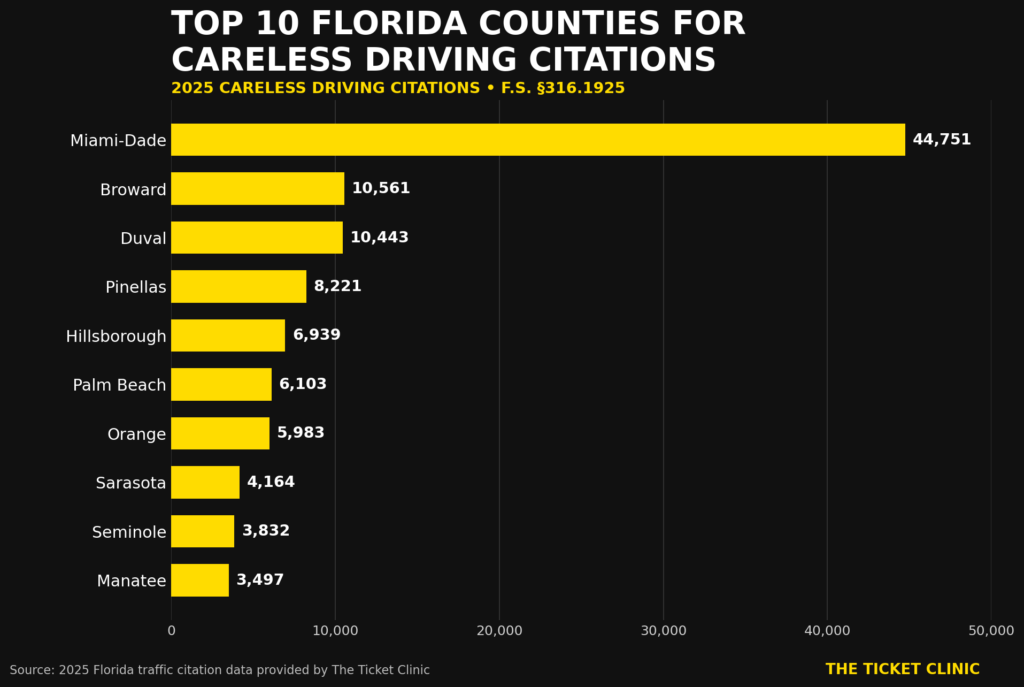
Among major Florida counties contained in the 2025 citation data analyzed by The Ticket Clinic:
| County | 2025 Careless Driving Citations |
|---|---|
| Miami-Dade | 44,751 |
| Broward | 10,561 |
| Duval | 10,443 |
| Pinellas | 8,221 |
| Hillsborough | 6,939 |
| Palm Beach | 6,103 |
| Orange | 5,983 |
| Sarasota | 4,164 |
| Seminole | 3,832 |
| Volusia | 3,287 |
| Polk | 3,073 |
| Lake | 2,559 |
| Brevard | 2,168 |
| Lee | 1,692 |
| Osceola | 1,506 |
| St. Lucie | 1,310 |
| Monroe | 744 |
| Leon | 547 |
These are raw citation totals, not population-adjusted rates, so they should not be interpreted as the probability that an individual driver will receive a ticket in each county.
Nevertheless, Miami-Dade stands out dramatically.
Miami-Dade recorded 44,751 careless driving citations in 2025, more than four times Broward County’s 10,561 and Duval County’s 10,443.
The data also suggests that enforcement practices can vary substantially between jurisdictions and agencies.
Who Writes Florida's Careless Driving Tickets?
Statewide 2025 citation data provides another interesting breakdown.
Of Florida’s 146,069 careless driving citations:
- City police departments: 67,857
- Florida Highway Patrol: 54,690
- Sheriff’s departments: 23,116
- Other agencies: 406
That means municipal police departments accounted for approximately 46% of Florida’s careless driving citations in 2025, followed by FHP at roughly 37%.
The long-term trend is particularly interesting.
FHP issued 90,476 careless driving citations in 2016 compared with 54,690 in 2025, a decline of approximately 40%.
City police departments went from 92,710 to 67,857, a decline of approximately 27%.
Sheriff’s departments declined more modestly, from 27,475 to 23,116, approximately 16%.
The numbers suggest that the decline in careless driving citations is not occurring uniformly across every type of law-enforcement agency.
What Are the Penalties for Careless Driving in Florida?
Careless driving is a moving violation rather than a criminal offense.
Florida Statute §316.1925 directs that the violation be punished under Chapter 318. The statutory base civil penalty for an ordinary moving violation that does not require a mandatory court appearance is $60, although the amount a driver actually pays can be higher because applicable court costs, assessments and other charges can be added.
The potential driver’s-license consequences are more important.
Under Florida’s point system, an ordinary moving violation generally carries 3 points.
However, Florida law assigns 4 points to a qualifying moving violation that results in a crash.
That distinction makes an accident-related careless driving ticket especially important.
Accumulating points can ultimately result in license suspension. Florida’s current point system provides for suspension when a driver accumulates:
- 12 points within 12 months: up to a 30-day suspension
- 18 points within 18 months: up to a three-month suspension
- 24 points within 36 months: up to a one-year suspension
Can a Careless Driving Ticket Affect Your Insurance?
Potentially—but Florida’s insurance rules are more nuanced than simply saying “any ticket makes your insurance go up.”
Florida law places restrictions on when an insurer can impose an additional premium or refuse to renew a policy solely because of noncriminal traffic infractions.
For example, Florida Statute §626.9541 generally restricts an insurer from imposing an additional premium or refusing renewal solely because of a single noncriminal traffic infraction, subject to statutory exceptions. The statute specifically addresses second infractions within 18 months and third or subsequent infractions within 36 months.
An accident changes the analysis significantly.
Florida law permits insurers to consider whether their information supports a good-faith determination that an insured was substantially at fault for an accident. The statute also identifies circumstances under which an insured may be entitled to reimbursement of an accident surcharge or policy renewal—for example, when a related citation was dismissed or when evidence demonstrates the insured was not at fault.
That makes the combination of:
accident + careless driving citation
potentially much more consequential than an isolated traffic ticket.
The accident can generate an insurance claim, while a conviction on the related moving violation may become part of the driver’s record.
Florida law also specifically provides protection when adjudication is withheld and no points are assessed under certain statutory procedures. However, there is an important exception for traffic infractions involving accidents in which the insurer incurred a loss because of the insured’s fault.
In other words, drivers should not assume that simply avoiding points automatically eliminates every possible insurance consequence when the ticket arose from an at-fault accident.
Why Fighting an Accident-Related Careless Driving Ticket Can Matter
An accident-related careless driving ticket presents two separate issues:
What happened in the accident?
y
Can the government prove the traffic violation?
Those questions may overlap, but they are not necessarily identical.
A driver may have an insurance claim proceeding at the same time that a traffic citation is being handled in court.
The disposition of the citation can therefore be important beyond simply paying a fine.
Florida’s insurance statute specifically recognizes situations in which an accident-related traffic citation is dismissed or nolle prossed when addressing accident surcharges and renewal protections.
An accident changes the analysis significantly.
Florida law permits insurers to consider whether their information supports a good-faith determination that an insured was substantially at fault for an accident. The statute also identifies circumstances under which an insured may be entitled to reimbursement of an accident surcharge or policy renewal—for example, when a related citation was dismissed or when evidence demonstrates the insured was not at fault.
That makes the combination of:
accident + careless driving citation
potentially much more consequential than an isolated traffic ticket.
The accident can generate an insurance claim, while a conviction on the related moving violation may become part of the driver’s record.
Florida law also specifically provides protection when adjudication is withheld and no points are assessed under certain statutory procedures. However, there is an important exception for traffic infractions involving accidents in which the insurer incurred a loss because of the insured’s fault.
In other words, drivers should not assume that simply avoiding points automatically eliminates every possible insurance consequence when the ticket arose from an at-fault accident.
How Do Traffic Lawyers Fight Careless Driving Tickets?
There is no single defense that applies to every careless driving case. A lawyer’s strategy depends heavily on how the citation was issued and the evidence available.
Several issues may be investigated.
What Did the Officer Actually Observe?
This can be particularly important in accident cases.
Was the officer present when the alleged careless driving occurred?
Or did the officer arrive after the crash?
If the officer arrived afterward, the case may depend upon statements from drivers and witnesses, physical evidence, vehicle damage, crash-scene evidence and other admissible evidence rather than the officer’s firsthand observation of the driving.
What Specific Conduct Was Allegedly Careless?
Section 316.1925 is broad, but the government still has to establish that the driver’s operation of the vehicle violated the statute.
A traffic attorney may examine what specific act allegedly constituted the failure to drive carefully and prudently.
Simply labeling conduct “careless” does not resolve the factual dispute over what actually happened.
Are There Conflicting Accounts of the Accident?
Drivers involved in collisions frequently disagree about what happened.
Questions may include:
- Which vehicle had the right-of-way?
- Was a vehicle already established in a lane?
- Did another driver make an unexpected maneuver?
- Was a traffic signal involved?
- Were there independent witnesses?
- Does the vehicle damage support one driver’s account?
- Is dashcam or surveillance footage available?
- Did weather, roadway conditions or visibility contribute to the collision?
These details can matter when challenging the officer’s conclusion.
Does the Physical Evidence Support the Citation?
Photos, video, vehicle damage, skid marks, roadway configuration and other evidence may tell a different story from an initial assumption made at the crash scene.
Dashcams and nearby surveillance cameras can be especially valuable because footage may provide objective evidence of what happened.
Can the Government Meet Its Burden?
Florida traffic infractions contested at a hearing must be proven beyond a reasonable doubt.
A traffic lawyer can evaluate whether the available testimony and evidence actually meet that burden.
Can Points or Adjudication Be Avoided?
Not every case ends with either a complete dismissal or a conviction as originally charged.
Depending on the facts, driving history, jurisdiction and court, an attorney may seek dismissal, challenge the evidence, negotiate an amended disposition, or seek a resolution designed to avoid points or adjudication when legally available.
The appropriate strategy depends on the individual case.
Should You Just Pay a Careless Driving Ticket After an Accident?
Paying a Florida traffic citation generally means resolving the citation without contesting the underlying charge.
Before doing that, it is worth considering more than the dollar amount printed on the ticket.
A careless driving citation can involve:
Points on your driver’s license.
A traffic conviction on your driving history.
Possible insurance consequences.
Additional significance when the citation resulted from a car accident.
Potential license consequences if you already have other points.
That is why an accident-related careless driving citation deserves particular attention.
Got a Careless Driving Ticket in Florida?
If you received a careless driving ticket, especially one issued after a car accident, consider having the citation reviewed before simply paying it.
The Ticket Clinic has represented Florida drivers in traffic cases for decades. Our traffic attorneys can review the circumstances surrounding the citation, the available evidence, your driving history and the potential consequences of the charge.
Every case is different, and past results do not guarantee future outcomes.
Text a picture of your ticket to 305305 for a fast and free quote.

The Ticket Clinic Team
We are the largest law firm in the United States to focus solely on traffic-related offenses and traffic tickets. Over +35 years in business, we have developed deep knowledge about traffic court procedure and traffic laws. Our goal is to help keep drivers stay informed about legal issues that could affect them on the road. In our blog content, we like to explore insights in traffic ticket trends and other related issues.